Here's something nobody tells you when you start a business Instagram account: the hardest part isn't making great content. It's showing up every single day to post it.
Life gets in the way. A client call runs long. An order needs your attention. You blink and it's Thursday, and you haven't posted since last Tuesday. Sound familiar? Yeah. It happens to almost every business owner we've talked to.
That's exactly what makes scheduled posting on Instagram worth figuring out. You put the work in once, upfront, and your account keeps running even when you're elbow-deep in everything else.
This content is about why it works, what it saves you from, and how an honest Instagram content strategy built around planning not scrambling can change how your account performs.
Instagram's algorithm isn't complicated, but it's a little unforgiving. Accounts that post regularly tend to get shown to more people. Accounts that go quiet for a few weeks? They lose ground. Fast.
Hootsuite's research on social media engagement patterns found that consistent posting is one of the strongest predictors of organic growth not fancy graphics, not perfect captions. Just showing up regularly.
And honestly? Most businesses don't have a content quality problem. They have a follow-through problem. The ideas are there. The photos exist. There's just no system to get them out the door on time. That's what scheduling solves. It's also worth keeping account security in mind early on knowing your options for Instagram account recovery before something goes wrong is a lot less stressful than figuring it out in the middle of a crisis.

We've all published something rushed. A caption that didn't quite land. A photo that felt a little off. When you're scrambling to post *something anything *the quality suffers, and you usually know it the second you hit publish.
Scheduling forces you to slow down. You're not writing captions under pressure at 7:50 AM. You're planning them on a quiet afternoon when you can actually think. That mental space makes a real difference not just in how your content reads, but in how it actually performs.
There's a meaningful difference between having an IG content strategy and just "posting stuff." A real strategy means your content connects across time you're teasing a launch before it happens, following up after a promotion ends, telling a story that unfolds over a few weeks.
That kind of intentional storytelling is almost impossible to pull off in real time. It only works when you can see the full picture in advance. Scheduling gives you that view.
Most scheduling tools pull your Instagram Insights data and show you when your followers are active. Turns out, posting at 7:45 AM for a US business audience will almost always outperform posting at 2:30 PM but you'd never know that if you're just posting whenever you find a free minute.
Sprout Social's research on Instagram posting times consistently points to mid-morning on weekdays as the sweet spot for most US business audiences. Scheduling makes it easy to hit those windows every single time, without setting yourself a daily alarm.
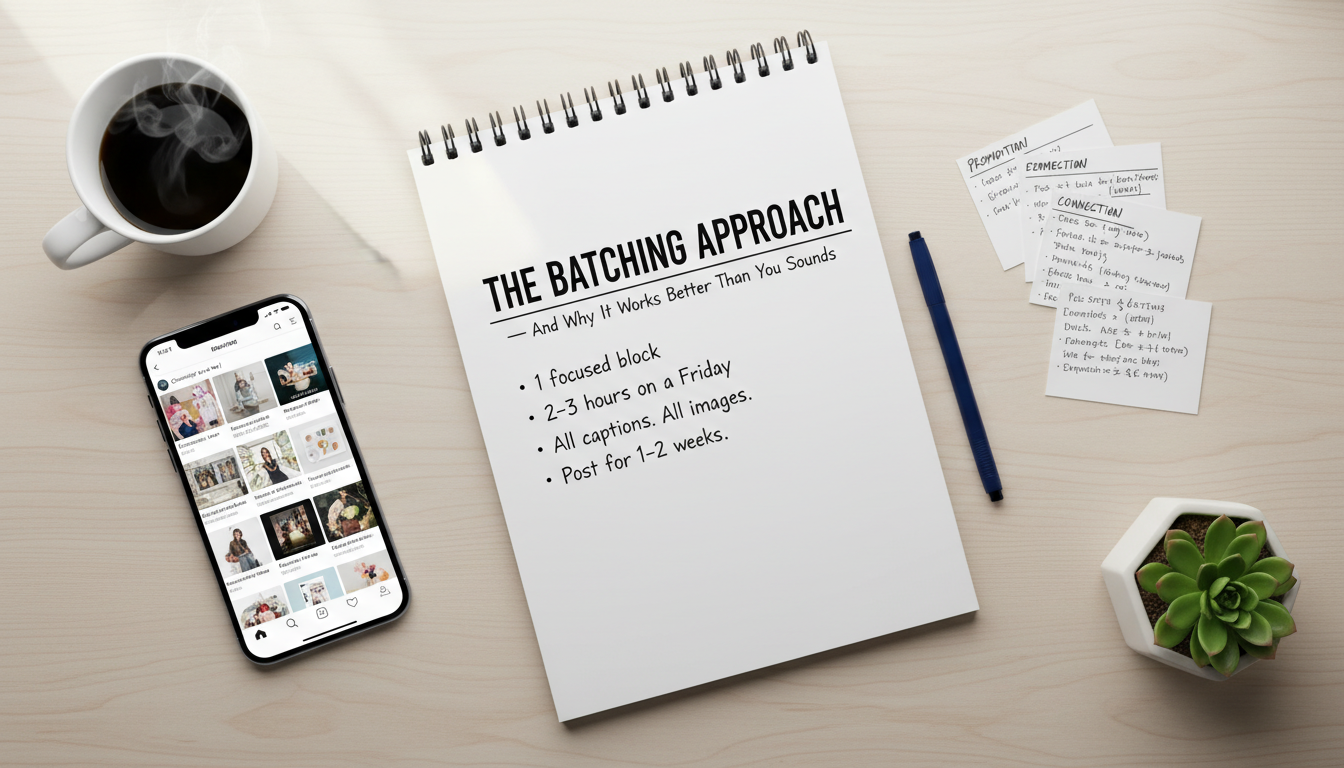
Here's a workflow we see succeed for small business owners and lean teams: instead of posting day by day, you set aside one focused block of time maybe two or three hours on a Friday and create everything for the following week or two at once. All the captions. All the image selections. Everything queued up.
Then you don't really think about it again until next week's session.
It sounds almost too simple. But batching your IG content this way changes how you approach it creatively. You're not switching mental gears every morning between "running my business" and "being a content creator." You get into the creative zone once, do the work, and then let the schedule take it from there.
It also makes your content more consistent overall. When you can read seven captions side by side, you catch the things that slip through otherwise the repeated phrases, the tonal inconsistencies, the imbalance between promotional posts and genuine connection posts. Hard to notice one at a time. Easy to see all at once.
And if you're managing this across multiple accounts or team members, having structured processes in place or even leaning on experienced social media support services can help ensure nothing falls through the cracks while you focus on growth.

A good Instagram content plan doesn't need to be complicated. Here's what actually works in practice:
Pick a cadence you can genuinely sustain. Three to five posts a week is solid for most businesses. Posting every day sounds ambitious until you burn out two weeks in and go completely dark for a month. Consistency beats intensity, every time.
Map your content to what's actually happening in your business. A product launch coming up? Build toward it for two weeks. Slow season? Use it to share behind-the-scenes moments and build some genuine connection with your audience. Your content calendar should mirror your business calendar not exist in its own separate world.
And leave room for the unexpected. Scheduling doesn't mean every post has to be locked in six weeks out. Keep 20–30% of your calendar flexible for timely stuff trending topics, spontaneous moments, things you couldn't have anticipated. The plan is a framework, not a straitjacket.
You've got solid options. Meta Business Suite is free and built right into your existing Facebook/Instagram setup good starting point, especially if you're just getting into this. Later has a really intuitive visual grid planner that a lot of businesses love for keeping their feed cohesive. Buffer keeps things simple and clean. Hootsuite is worth the cost if you're managing multiple accounts or have a small team that needs to collaborate.
One small habit that pays off: set a reminder to review your queue 24 hours before posts go live. Trends move fast. Something you wrote two weeks ago might need a small tweak to stay relevant or to avoid landing awkward given something that happened in the news. Quick check, big payoff.
You can have the most organized content calendar in the world and it means nothing if something goes wrong with your actual account. Hacks happen. Accounts get disabled over policy misunderstandings. Passwords get lost after team changes. And when any of that happens, all that planned content just sits there, unpublishable.
If you ever find yourself locked out, social media support services are worth knowing about before you need them. They specialize in account recovery services for a whole range of situations. Kind of like backing up your phone you're really glad you knew about it when the moment comes.
Does using a third-party scheduling tool hurt your Instagram reach?
Not if the tool connects through Instagram's official API Meta Business Suite, Later, Buffer, and Hootsuite all qualify. Instagram doesn't penalize posts from approved platforms. The algorithm cares about engagement and consistency, and good scheduling genuinely helps you improve both.
When's the best time to post on Instagram for a US business audience? Mid-morning on weekdays, especially Tuesday through Friday, between 9 and 11 AM local time tends to perform well, based on Sprout Social's data. That said, your own Insights are more valuable than any general benchmark, because your specific audience might behave differently.
How far in advance should I actually plan my Instagram content?
Two weeks tends to be the sweet spot. It's far enough ahead to be intentional, but close enough that your content still feels current. For launches or bigger campaigns, plan a month out. For everyday posts, two weeks works really well.
Can you schedule Instagram Reels and Stories, or just feed posts?
Yes to both and honestly, Reels especially. Instagram is currently pushing short-form video harder than almost anything else in the algorithm. Tools like Later and Meta Business Suite support Reels scheduling. If you're not using it yet, it's worth prioritizing.
What do I do if my scheduled posts just stop going out?
Nine times out of ten, it's an API connection issue usually triggered by a password change or a security prompt that broke the link between your scheduling tool and Instagram. Go back into your tool, reconnect your account, and review your queued posts to make sure everything still looks right.
Showing up consistently on Instagram is less about discipline and more about having a system that does the heavy lifting for you. Scheduled posting on Instagram removes the daily decision fatigue, helps you publish at the right times, and gives you the mental space to focus on what you're actually saying instead of just scrambling to say something.
Build a simple plan. Batch your content two weeks at a time. Use a tool that fits how you work. And make sure your account is protected so all that effort doesn't disappear overnight.
.avif)



.avif)


.png)
.png)
.png)
.png)