You nailed the shot. The lighting's perfect, the caption's clever, you even remembered the hashtags. You hit post: and then… silence. A handful of likes from the same three people who always show up, and nothing else. No new followers, no saves, no shares.
If that sounds familiar, here's something worth considering: your content might not be the problem. Your timing might be.
Instagram's algorithm in 2026 still rewards early engagement above almost everything else. A post that lands when your audience is actively scrolling has a fundamentally different trajectory than one that drops into the void at 2 AM. So when is the best time to post on Instagram if you want real reach? And does it actually matter as much as people say?
Short answer: yes. Long answer: it depends: and this guide will walk you through both.
A lot has changed on Instagram over the years. The feed isn't chronological anymore, Reels have taken over discovery, and the algorithm has gotten increasingly sophisticated. But one thing hasn't changed: early engagement still acts as a signal that tells Instagram whether to push your content further.
When a post earns likes, comments, saves, and shares quickly after going live, the algorithm interprets that as a quality signal and distributes it to a wider audience. When that first-hour engagement is slow? The post stalls: sometimes permanently.
According to Sprout Social's 2025 best times to post research, Instagram posts published during high-activity windows consistently see stronger initial reach than identical content posted at off-peak hours. That gap compounds over time: a post that gets 200 likes in the first hour behaves very differently from one that takes all week to get there.
This isn't about gaming the system. It's about meeting your audience where they already are.
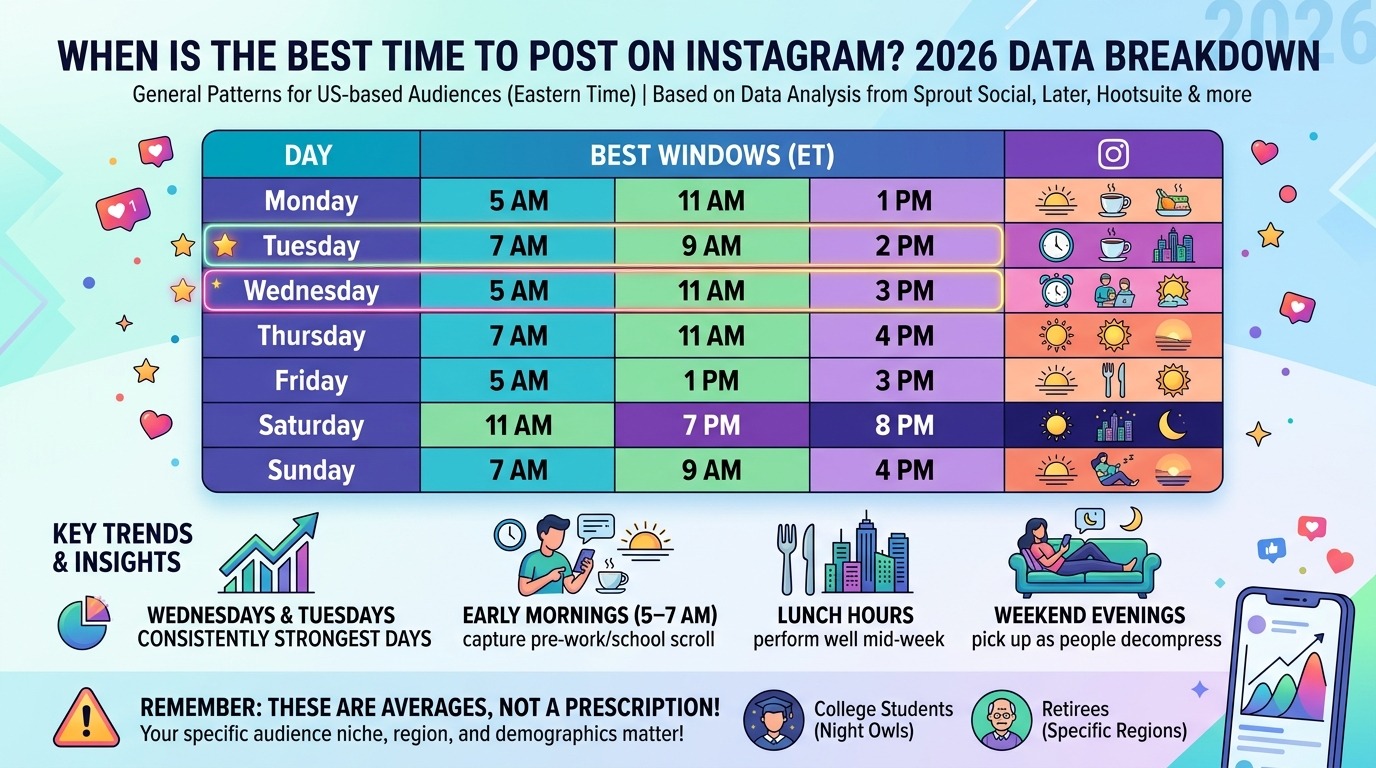
Let me cut straight to what the research shows for US-based audiences in 2026. Multiple analytics platforms: Sprout Social, Later, and Hootsuite among them: have tracked engagement patterns across millions of accounts, and while results vary by niche and audience, some clear patterns hold up across the board.
Here's a general framework by day for Eastern Time:
Day
Best Windows (ET)
Monday
5 AM, 11 AM, 1 PM
Tuesday
7 AM, 9 AM, 2 PM
Wednesday
5 AM, 11 AM, 3 PM
Thursday
7 AM, 11 AM, 4 PM
Friday
5 AM, 1 PM, 3 PM
Saturday
11 AM, 7 PM, 8 PM
Sunday
7 AM, 9 AM, 4 PM
Wednesdays and Tuesdays consistently rank as the strongest overall days. Early mornings: especially that 5–7 AM window: capture the pre-work scroll. Lunch hours perform well mid-week. Weekend evenings pick up as people decompress.
One thing worth noting: these are averages across large, diverse account sets. They're a solid starting point, but they're not a prescription. If your audience skews toward college students, night owls, or retirees in a specific region, your actual peak windows could look completely different.
This is where things get more interesting: and more useful. Platform-wide averages matter less than the behavior of your specific community.
Here's how different content categories tend to break down:
The takeaway here is that the optimal posting window isn't just about when Instagram users are active in general: it's about when your specific audience is in the right headspace for your specific type of content. Those are two different questions, and both matter.
If you've ever had an account go quiet after a username change or an unexpected access issue, getting that account back is its own challenge: one that Instagram account recovery specialists can help you work through before your timing strategy even kicks in.
Here's the thing about all the benchmarks above: your own analytics will beat them every time. Instagram gives you the data you need; most people just don't look at it.
If you have a Creator or Business account (and if you're serious about growth, you should), here's exactly what to do:
Step 1: Go to your profile and tap the hamburger menu (three lines) in the top-right corner.
Step 2: Tap Insights, then scroll to the Your Audience section.
Step 3: Tap See All under Followers, then scroll down to Most Active Times. You'll see a breakdown by hours and days.
Step 4: Cross-reference those active windows with your top-performing posts. Look for overlap: that's your sweet spot.
Step 5: Test it. Post consistently in those windows for 4–6 weeks and track whether your first-hour engagement improves.
This process isn't glamorous, but it's the most reliable way to move from generic recommendations to a schedule that actually reflects how your audience behaves.
Timing is one lever. But if you're trying to maximize engagement specifically: not just reach: there are a few things that work in combination with good timing.
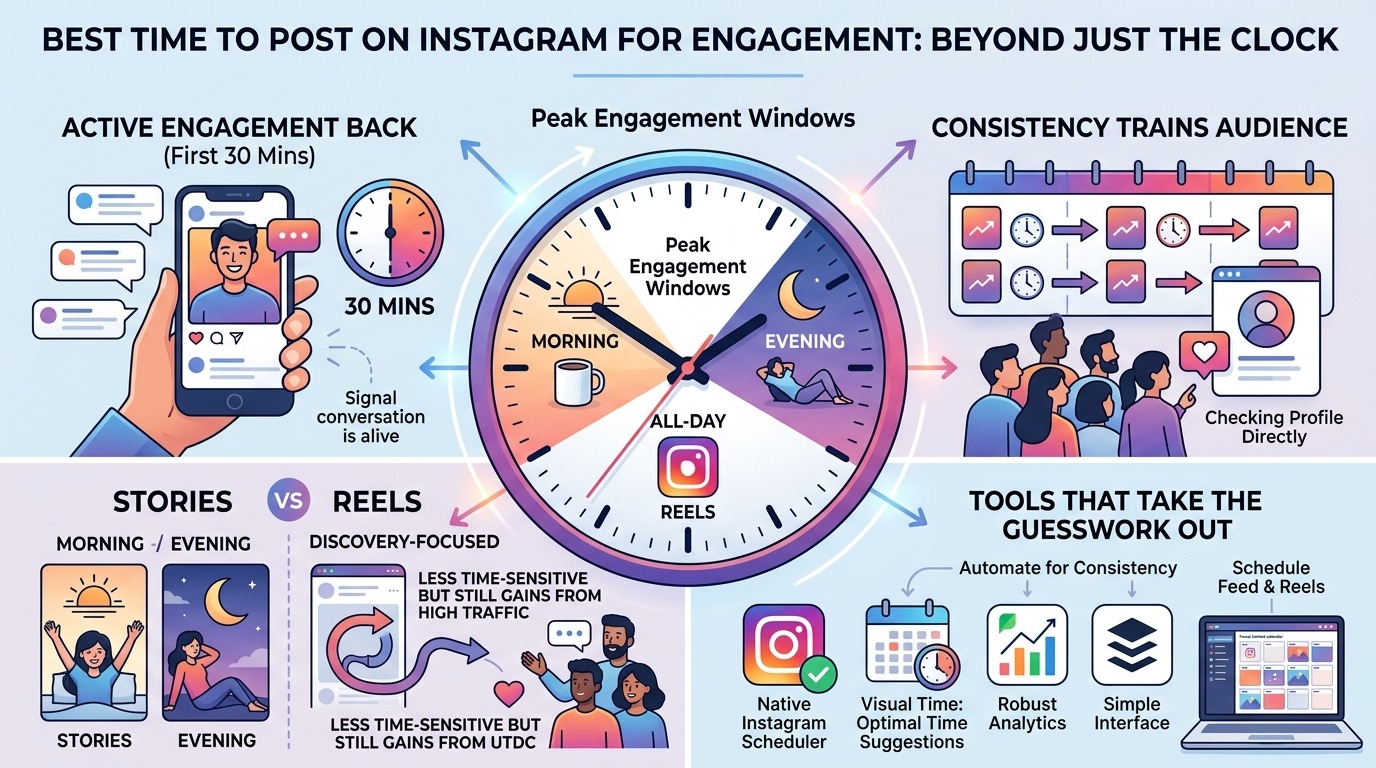
Post when you can actively engage back. If you post and then go offline for four hours, you're leaving interactions on the table. The comments you respond to in the first 30 minutes signal to Instagram that the conversation is alive, which keeps the post circulating longer.
Consistency trains your audience. When you post at the same times regularly, your followers start to anticipate your content. Over time, some of them will check your profile directly: which is one of the strongest engagement signals Instagram recognizes.
Stories and Reels have different timing dynamics. Stories peak in the morning (before people start their day) and again in the evenings. Reels, because they're discovery-focused, are less time-sensitive than feed posts: but still benefit from landing during high-traffic windows.
If you're building out a more comprehensive presence across platforms and want the right handle to match, it's worth looking into an Instagram username claim if your preferred name is tied up: because a consistent, on-brand username helps every other piece of your strategy work better.
Manually tracking all of this is possible, but scheduling tools make it much easier to stay consistent without being chained to your phone:
The goal isn't to automate everything: it's to make sure your content is going live at the right moment even on days when you're busy, travelling, or simply not thinking about it.
For creators managing multiple aspects of their online presence, working with social media support services can also help ensure your broader strategy, including timing, account health, and profile optimization: stays on track.
When is the best time to post on Instagram for a US audience in 2026?
For most US creators, the strongest windows are Tuesday and Wednesday mornings between 7–11 AM ET, weekday lunch hours around 11 AM–1 PM, and weekend evenings from 7–9 PM. These reflect when American users are most actively scrolling. Your own Instagram Insights data will give you a more personalized breakdown based on your specific followers.
Does posting time actually affect how many people see my Instagram posts?
Yes: Instagram's algorithm prioritizes posts that earn fast engagement after going live. A post that gets strong interaction in the first 30–60 minutes is more likely to be pushed to the Explore page and shown to non-followers. Posting during high-activity windows gives your content a real head start on that early momentum.
How do I find the best time to post for my specific Instagram audience?
Go to Instagram Insights, tap "Your Audience," and scroll to Most Active Times. This shows you a day-by-day and hour-by-hour breakdown of when your followers are online. Cross-reference that with your best-performing posts and schedule future content in those overlapping windows for the strongest results.
Is there a difference between the best posting time for Reels vs. feed posts? Feed posts are more time-sensitive because they compete directly with other posts in your followers' feeds. Reels have a longer discovery lifespan since they circulate through the Explore and Reels tabs: but they still benefit from early engagement to trigger wider distribution. Morning and evening windows work well for both formats.
How often should I post on Instagram to maximize reach in 2026?
Most growth-focused accounts post 4–7 times per week across a mix of feed posts, Reels, and Stories. Consistency matters more than volume: a reliable posting rhythm helps Instagram's algorithm understand and predict your content patterns. Posting sporadically, even with high-quality content, makes it harder to build steady momentum.
Your content does the heavy lifting: but timing gives it a fighting chance to be seen. The best time to post on Instagram for a US audience in 2026 generally falls in the early morning, around midday on weekdays, and during weekend evenings. But the most accurate answer? It lives in your own Insights tab.
Start with the data, run 4–6 weeks of consistent testing, and adjust as your audience tells you what works. Over time, you won't be guessing anymore: you'll know.
Ready to stop posting into the void? Lock in your schedule, stay consistent, and let your audience's behavior guide the clock.
.avif)



.avif)


.jpg)
.png)
.png)